
You're about to spend somewhere between $80k and $250k on a machine that has to earn its keep for the next fifteen years. Get the spec wrong and you've bought a brake that can't hit your work, or one you've paid a premium for and never use to capacity. Get the support wrong and you've bought a machine that sits dead on the floor at the worst possible moment.
Most guides stop at the first problem. This one covers both — because on a shop floor, they're the same decision.
Start with the work, not the machine
Before tonnage, before bed length, before any brochure: what are you actually bending? Material type, thickness, longest part, tightest radius, and how many hits a day. Everything downstream falls out of that. A brake sized for your biggest occasional job will be a slow, expensive way to fold your bread-and-butter work all day.
Spec the machine to your typical job, and keep a plan for the outliers — subcontract them, or size up one bracket deliberately with your eyes open. Don't let the one big job you did last year size your whole purchase.
Tonnage: the number everyone gets wrong
Tonnage is where the generic buyer checklists reach for a single formula and call it done. Be careful with that.
Air bending mild steel gives you a workable rule of thumb, but it is only valid for a specific material, a specific die opening, and air bending as the method. Change any one of those and the number moves:
- Material matters. Stainless can need roughly 50% more tonnage than mild steel of the same thickness; aluminium needs less. A rule quoted for mild steel will underspec you on stainless.
- Die opening matters. A wider vee lowers the tonnage required but opens your inside radius; a narrow vee tightens the radius but drives tonnage up fast. The die you choose changes the tonnage before you've bent anything.
- Bottoming and coining need far more. If your work needs bottoming or coining rather than air bending, tonnage climbs steeply — sometimes several times the air-bend figure.
The honest version: use the air-bend figure as a starting estimate for your dominant material and method, then confirm it against the specific tooling and bends you actually run. A number that ignores material, die and method isn't a spec — it's a guess dressed up as one.
Bed length and back gauge
Bed length (and open height, and stroke) is set by your longest part plus room to handle it — and by the tooling you'll segment across the bed. Longer isn't automatically better: a longer bed with the same tonnage means less tonnage available per metre when you're bending across the full length, so the two specs have to be read together.
The back gauge is quietly one of the most important parts of the machine for real production. Axis count, travel and repeatability decide how quickly and consistently you can run multi-bend parts. A cheap gauge on an otherwise good frame will cost you in setup time on every job for the life of the machine.
The control is the decision that compounds
Here's where the spec guides go quiet. They give you a tier list of controls — entry, mid, high — and move on. But the control is not just another line item. It's the part of the machine you touch every single shift, and it's the part most likely to strand you.
The frame bends metal. The control decides how easily, how repeatably, and how much of your day you lose when something's wrong.
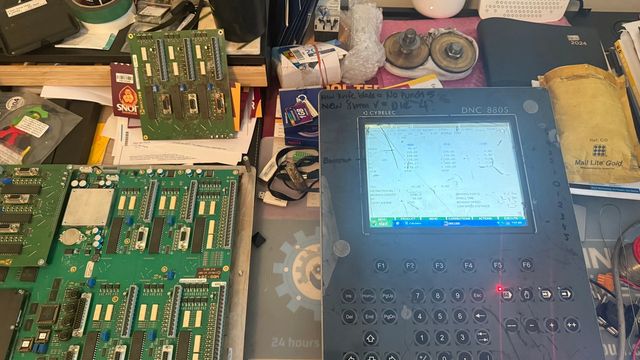
A modern press brake is a Delem, Cybelec, Heidenhain or similar CNC control driving the machine. That control is where your bend sequences live, where angle correction happens, where operator time is won or lost. When a machine "faults," nine times out of ten it's the control throwing a code, not the frame failing.
So the real questions about the control aren't just "how many axes" and "does it have a 2D graphic screen." They're:
- Who programs it when you bring on a new part family?
- Who diagnoses it when it throws a code you've never seen?
- Who retrofits it in eight years when the original electronics are obsolete but the frame is still perfectly good?
Who keeps it running after delivery?
This is the question every ranking guide ignores, and it's the one that actually decides your risk.
A machine purchase isn't the day of delivery. It's commissioning — is it set up, levelled, calibrated and programmed for your work, or dropped on the floor with a manual? It's the first fault six months in. It's the operator who needs training. It's the retrofit years down the track.

Each of those stages runs through the control. And here's the trust logic worth thinking hard about: if the people who sell you the machine also program and service that control in-house, then commissioning, faults, training and retrofits are all handled by one party who knows the machine because they set it up. If the seller subcontracts all of that, you're now managing a chain of strangers every time something goes wrong.
At A1 EMS, that's the whole model. We're factory-trained across Delem, Cybelec, Heidenhain, Beckhoff and more — the same controls that sit on these machines — and we do the diagnostics, programming, commissioning and retrofits ourselves. We're independent, so we recommend the machine that suits your shop rather than the one we're contracted to move. And because we service what we supply, "who shows up when it faults?" has a name attached to it.
A short checklist before you sign
- Tonnage confirmed against your actual material, die opening and bend method — not a generic mild-steel figure.
- Bed length and tonnage-per-metre read together for your longest real part.
- Back gauge axes and repeatability matched to your multi-bend work.
- Control chosen for the work and for who can program and service it locally.
- Support answered in a sentence: who commissions it, who programs it, who comes when it faults.
The spec is the easy half. Any brochure can quote you tonnage and a bed length. The half that decides whether this machine makes you money is the half the brochures skip — and it's worth a conversation with the person who'll actually set it up and support it, not just the person who ships the box.
Weighing up a press brake purchase? Talk to us about the machine and the control before you commit — we'd rather help you spec it right than sell you the wrong one.